AI-powered strawberry counting and ripeness classification
The vision pipeline combines object detection, ripeness classification, and density analysis to compute fruit counts by block and row.
Model outputs are field-calibrated, reported with confidence scores, and used to generate re-scan recommendations for low-confidence zones.
-
01
Object detection + counts
Fruit counts are generated automatically by plant, row, and block.
-
02
Ripeness classification
Distribution is reported for 0% / 25% / 50% / 75% / 100% maturity.
-
03
Confidence score + error analysis
Low-confidence regions are flagged with a validation checklist.
What does the model produce?
The counting module converts raw imagery into operational metrics: counts, ripeness classes, density, and confidence in one data set.
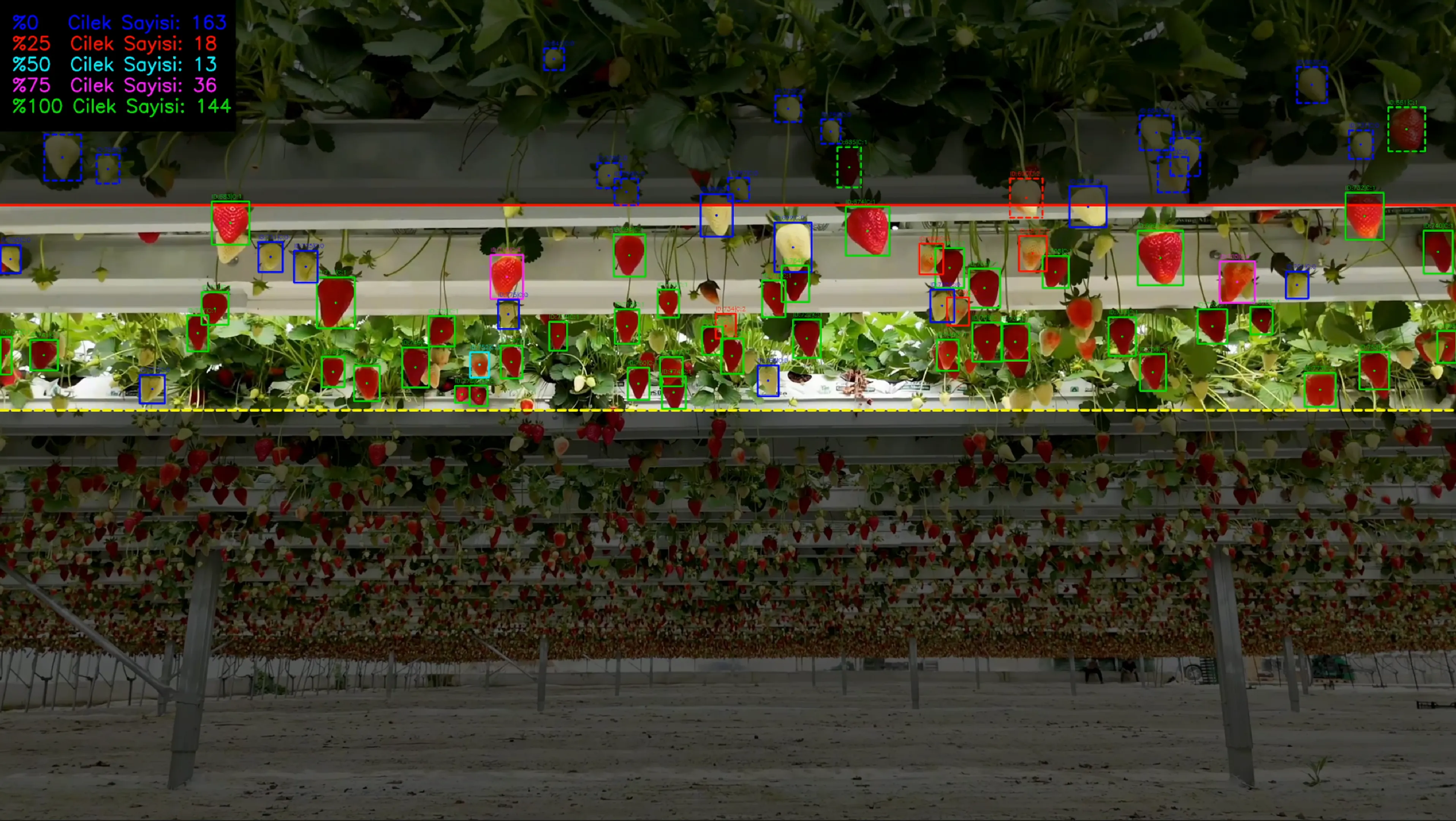
3 technical challenges solved by the algorithm
As model quality improves, field decisions become more reliable.
Missed fruit under dense canopy
Multi-sampling in low-visibility regions improves recall performance.
Variable light and shadow conditions
Light normalization and field thresholds reduce misclassification rates.
Model shift across cultivar and greenhouse types
Periodic calibration keeps model performance stable across varieties.
Challenge → Solution → Benefits
The AI counting engine makes ripeness data reliable and measurable.
Challenge
Manual counting and visual estimates create inconsistent block-level outputs.
Solution
An AI model extracts counts and ripeness classes with periodic calibration.
Benefits
- More stable counting accuracy
- Ripeness-based prioritization
- Confidence-scored operational data
Technical Specifications
The AI counting stack delivers classified detection with confidence scoring.
| Parameter | Detail |
|---|---|
| Model type | Computer vision detection + classification |
| Output | Count + ripeness class + confidence score |
| Validation | Periodic field-sample calibration |
| Integration | SeraERP API / CSV |
| Visualization | Density and confidence maps |
| Application | Greenhouse + tunnel areas |