Drone Harvest Detection: From Forecast to Plan
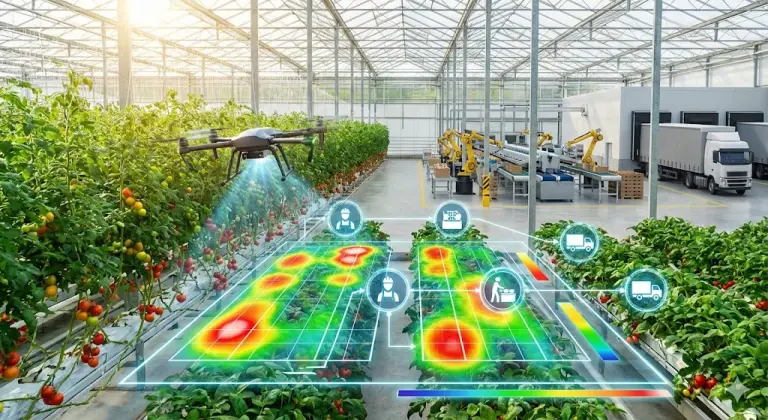
Drone harvest detection maps crop maturity across greenhouse blocks through imagery and AI analysis. The resulting data turns labor, packing, and logistics forecasts into a measurable harvest plan.
Revenue in greenhouses is written at harvest. If harvest isn't managed correctly, even good production turns into loss: fruit waits on the plant, quality drops, waste increases, packaging bottlenecks, and logistics are delayed. The critical issue: harvest is still planned by estimation in most operations.
Our Drone Harvest Detection solution makes ripeness density visible by block and row, forecasts daily/weekly harvest volumes, and brings labor, packaging, and logistics into a single plan.
Five critical problems that disrupt harvest planning in greenhouses (and clear solutions)
-
No clear answer to "How many people do we need today?"
Problem: Labor is either short or excessive.
Solution: Drone detection shows harvest density by block, enabling staffing plans for the right day and block.
-
Fruit waits on the plant and quality standards slip
Problem: When ripe fruit is not harvested on time, Brix, shelf life, and sizing fluctuate.
Solution: Ripeness maps enable prioritization and clarify which block is harvested first.
-
The packaging line bottlenecks or capacity goes unused
Problem: Harvest and packaging capacity are not synchronized.
Solution: Estimated harvest volume sets packaging shifts, materials, and line plans in advance.
-
Packaging and cold storage prep is left to the last minute
Problem: Boxes, labels, pallets, and storage capacity create last-minute crises.
Solution: Drone outputs prepare packaging and cold storage plans day by day, so shipment windows are not missed.
-
Management falls into daily firefighting mode
Problem: Constant intervention and low predictability.
Solution: Harvest becomes an operational plan, not just a report; teams follow the same standard.
What does drone harvest detection deliver?
- Harvest density and ripeness map: block and row level
- Estimated harvest volume: daily/weekly plan
- Harvest prioritization: ordering that protects quality
- Labor planning template: headcount and block allocation
- Packaging and logistics synchronization plan
Why is it stronger with SeraERP and the Technology-Driven Delivery model?
- Harvest plan -> automatic work orders
- Staffing plan -> shift and performance tracking
- Packaging/labels -> inventory and consumption management
- Logistics -> on-time delivery and quality tracking
Quick start: 7-14 day pilot in the field
- Discovery: blocks, crop stages, harvest rhythm, operational capacity
- Pilot flight plan: weekly measurement rhythm
- Map and forecast outputs: initial plan set
- Operational integration: labor, packaging, logistics templates
- Rollout: standardization across all blocks
Conclusion
Harvest is the greenhouse's cash flow. Drone harvest detection removes harvest from guesswork and turns it into a plan. Labor, packaging, and logistics run in the same rhythm; quality standards are protected; waste and delay costs drop.