SYSTEMS

Three core systems that set the field standard

Fertima consolidates operations into three systems. Each one moves the field from infrastructure to measurable performance.

System 01

Harvest Collection System

System 02

Fertigation & Irrigation Systems

System 03

Digital Solutions

ROBOTIC HARVEST

The world's first commercial harvesting robot

Fertima brings the world's first commercial robotic strawberry harvesting solution to growers in Turkey. Autonomous harvesting delivers speed and precision together, selecting ripe fruit without damage and reducing labor needs. Real-time data capture boosts yield and standardizes quality.

Commercial-scale autonomous harvesting
FERTIGATION & IRRIGATION

Fertigation & Irrigation Systems

EC-pH dosing, irrigation automation, and greenhouse control come together in one architecture. Recipe management, remote monitoring, and alerts optimize water and nutrient use. Climate and root-zone performance stay in the same standard.

EC-pH controlled dosing backbone
DIGITAL SOLUTIONS

Digital Solutions

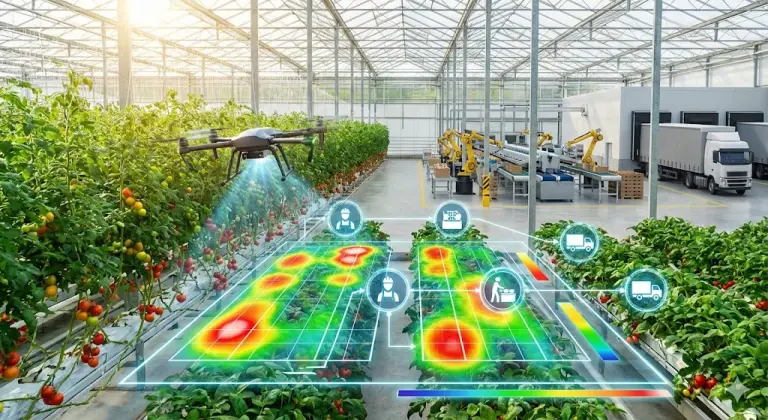
SeraERP, strawberry counting, and early warning tools unify production, labor, and quality data in one panel. Daily planning, task tracking, and reporting become simple. Data-driven decisions reduce losses and scale operations.

Operational visibility in one panel
OUTCOMES

Measurable outcomes across three systems

Fertima links field operations to data, making performance visible and repeatable.

Stable harvest quality Autonomous harvesting protects quality standards and reduces loss.
Controlled root zone EC-pH dosing and irrigation automation stabilize the root zone.
Data-driven operations Production, labor, and AI insights align into daily plans.
Combined view of Fertima systems
Blog

Latest Industry Articles

No posts found for the selected filters.

EC-pH controlled fertigation
Munters

EC-pH Controlled Fertigation: Stable Production with Munters GreenClimate

We combine root zone control with climate strategy to reduce quality fluctuations and establish an operating standard.

Read More
SeraERP management panel
SERAERP

SeraERP: The Operating System That Makes Cost per Kg Visible

Unifies production, labor, inventory, maintenance, and logistics data on one screen, tying decisions to measurement.

Read More
Drone harvest detection
Drone

Drone Harvest Detection: From Forecast to Plan

Plan labor, packaging, and logistics day by day with a block-level ripeness map.

Read More
Soilless farming
Cocopeat

Choosing the Right Cocopeat: Batch-Based Standardization

Ensures a stable root zone all season, more uniform growth, and a wider irrigation window.

Read More
Drone disease detection
Fertima AI

Drone Disease Detection: Early Warning and Targeted Intervention

Detect anomalies early, manage risk with targeted intervention, and protect quality standards.

Read More
Technology-driven delivery approach
Technology-Driven Delivery

Is Control in Your Hands? Greenhouse Management with Technology-Driven Delivery

Connect greenhouse management to a system, not a person, with measurement + authority + logging.

Read More

EC-pH Controlled Fertigation: Move to Profitable and Stable Production with Munters GreenClimate

Reading time: 4-5 min

By combining root zone control with a climate strategy, we reduce quality fluctuations and build an operating standard.

Details
EC-pH controlled fertigation system

In greenhouses, the "hidden determinant" of performance is the root zone. But to truly control the root zone (EC-pH), the climate side must be managed with the same discipline. Because the plant's water and nutrient uptake is directly shaped by climate parameters such as temperature, humidity, and air flow.

At the center of this approach is Munters GreenClimate. GreenClimate provides a comprehensive climate control system for greenhouses, aiming to maximize efficiency and yield. We bring EC-pH controlled fertigation discipline to the field with Munters controller architecture, delivering a working system with commissioning, training, and operating standards.

What do we change?

  1. We reduce fluctuations (quality standard)

    Even if EC-pH is on target, quality fluctuations grow if the climate is unstable. When you manage greenhouse climate with GreenClimate, the root zone behaves more consistently; as a result, Brix, sizing, and shelf life stability improve.

  2. We strengthen measurement (wrong measurement = wrong control)

    Munters GreenBox T&H is a solution with high-precision sensors that improve temperature and humidity measurement in the greenhouse. More accurate measurement means more accurate climate response and less stress in the root zone.

  3. We simplify operations (remote access and standard operation)

    Munters CommBox supports remote access to controllers like GreenClimate for climate/irrigation/fertigation. In multi-block structures, it strengthens the goal of standardized operation from a single center.

Why us?

As Fertima, we serve as a solutions partner in the Munters ecosystem in Turkey; with field commissioning and technical support, we focus not on installing and leaving the system, but on making it deliver performance in operation.

Quick start: a 3-step roadmap

  1. Discovery & suitability analysis (zones, airflow, measurement points, drainage/EC trend)
  2. Target sets & alarm architecture (climate strategy + EC-pH recipe ranges)
  3. Commissioning & training (standard operation that reduces operator dependency)

SeraERP: The Operating System That Makes Cost per Kg Visible in Greenhouses

Reading time: 4-5 min

Unifies production, labor, maintenance, and logistics data on one screen; ties decisions to measurement.

Details
SeraERP management panel

The biggest problem in greenhouses is often not production, but the inability to manage production. Even with good harvests in the same greenhouse, profitability can decline because most operations can't answer these questions clearly and quickly:

  • How much does 1 kg of product cost me?
  • Where does labor go, and where is the inefficiency?
  • Why aren't harvest, packaging, and logistics in sync?
  • What is the real cost of waste, quality loss, and delays?

SeraERP is an end-to-end greenhouse operating system designed to solve this invisible management problem by standardizing field operations. It unifies production, labor, inventory, maintenance, quality, harvest, packaging, and logistics in a single data layer, tying decisions to measurement rather than intuition.

The 6 most common greenhouse problems and SeraERP's clear solution

  1. The question "Are we profitable?" isn't clear even at month-end

    Problem: Costs are fragmented; labor, energy, and waste are tracked separately.

    Solution: SeraERP consolidates all cost items in one model to make true cost per kg visible.

  2. Labor grows but production doesn't scale at the same pace

    Problem: Shifts, tasks, block allocation, and performance measurement are unclear.

    Solution: Work-order logic records "who-did-what-when-where," and productivity metrics are managed.

  3. There is harvest, but packaging bottlenecks; logistics can't keep up

    Problem: Harvest plans, packaging capacity, and logistics slots are not integrated.

    Solution: SeraERP handles harvest, packaging, and logistics in one flow, synchronizing operations.

  4. Waste is accepted as normal, but no one knows the source

    Problem: Waste reasons are not coded; quality loss is not measured.

    Solution: Waste and quality loss are logged with reason codes and analyzed by block, team, and date.

  5. Maintenance and breakdowns silently eat production

    Problem: Unplanned downtime creates invisible costs.

    Solution: Periodic maintenance schedules, fault logs, and spare-parts tracking reduce unplanned downtime.

  6. Certification and audits face scattered data

    Problem: Batch, application, harvest, and logistics data are kept in fragments.

    Solution: SeraERP simplifies audits with batch-level logging and traceability.

Why is SeraERP different?

  • Single-screen management panel: daily and weekly KPIs
  • Work order and block-based operations: digital trace of field activity
  • Harvest -> packaging -> logistics flow: one process, one data source
  • Cost engine: true cost per kg + scenario comparison
  • Authorization/approval logic: enterprise control that reduces dependency on individuals

Quick start: a setup that delivers visible results in 10 days

  1. Discovery & KPI selection: what do we want to see on the management panel?
  2. Block-workflow mapping: harvest, maintenance, packaging processes
  3. Cost breakdown: labor, energy, inputs, waste items
  4. Pilot commissioning: start with 1-2 blocks, measure, improve
  5. Rollout: standardize across the entire greenhouse

Conclusion

Greenhouse profitability grows by managing what you produce before producing more. SeraERP makes cost per kg visible, measures labor, synchronizes harvest- packaging-logistics, and connects operations to data rather than individuals.

Drone Harvest Detection: From Forecast to Plan for Labor and Logistics

Reading time: 4-5 min

A drone detection approach that turns harvest management from forecast to plan.

Details
Drone-supported harvest planning

Revenue in greenhouses is written at harvest. If harvest isn't managed correctly, even good production turns into loss: fruit waits on the plant, quality drops, waste increases, packaging bottlenecks, and logistics are delayed. The critical issue: harvest is still planned by estimation in most operations.

Our Drone Harvest Detection solution makes ripeness density visible by block and row, forecasts daily/weekly harvest volumes, and brings labor, packaging, and logistics into a single plan.

Five critical problems that disrupt harvest planning in greenhouses (and clear solutions)

  1. No clear answer to "How many people do we need today?"

    Problem: Labor is either short or excessive.

    Solution: Drone detection shows harvest density by block, enabling staffing plans for the right day and block.

  2. Fruit waits on the plant and quality standards slip

    Problem: When ripe fruit is not harvested on time, Brix, shelf life, and sizing fluctuate.

    Solution: Ripeness maps enable prioritization and clarify which block is harvested first.

  3. The packaging line bottlenecks or capacity goes unused

    Problem: Harvest and packaging capacity are not synchronized.

    Solution: Estimated harvest volume sets packaging shifts, materials, and line plans in advance.

  4. Packaging and cold storage prep is left to the last minute

    Problem: Boxes, labels, pallets, and storage capacity create last-minute crises.

    Solution: Drone outputs prepare packaging and cold storage plans day by day, so shipment windows are not missed.

  5. Management falls into daily firefighting mode

    Problem: Constant intervention and low predictability.

    Solution: Harvest becomes an operational plan, not just a report; teams follow the same standard.

What does drone harvest detection deliver?

  • Harvest density and ripeness map: block and row level
  • Estimated harvest volume: daily/weekly plan
  • Harvest prioritization: ordering that protects quality
  • Labor planning template: headcount and block allocation
  • Packaging and logistics synchronization plan

Why is it stronger with SeraERP and the Technology-Driven Delivery model?

  • Harvest plan -> automatic work orders
  • Staffing plan -> shift and performance tracking
  • Packaging/labels -> inventory and consumption management
  • Logistics -> on-time delivery and quality tracking

Quick start: 7-14 day pilot in the field

  1. Discovery: blocks, crop stages, harvest rhythm, operational capacity
  2. Pilot flight plan: weekly measurement rhythm
  3. Map and forecast outputs: initial plan set
  4. Operational integration: labor, packaging, logistics templates
  5. Rollout: standardization across all blocks

Conclusion

Harvest is the greenhouse's cash flow. Drone harvest detection removes harvest from guesswork and turns it into a plan. Labor, packaging, and logistics run in the same rhythm; quality standards are protected; waste and delay costs drop.

Choosing the Right Cocopeat: The Key to Batch-Based Standardization

Reading time: 4-6 min

Cocopeat is not a consumable; it's the root zone infrastructure. The right choice keeps the root zone stable all season.

Details
Cocopeat and soilless production

One of the most expensive mistakes in a greenhouse is the quietest one: the wrong cocopeat. No matter how strong your climate control and EC-pH systems are, if the growing medium is unstable, production fluctuates; quality standards break down; salinity and root stress risks increase. Cocopeat is the infrastructure of the root zone, and if it's wrong, the impact of all your other technology investments declines.

1) Each crop needs its own cocopeat

Cocopeat is an engineered root medium. The root medium provides three things at once:

  • Water holding capacity
  • Air/oxygen capacity (air-filled porosity)
  • Ion environment and buffering (CEC, K/Na load, Ca/Mg balancing)

Different crops and production strategies differ in root oxygen demand, water uptake rhythm, and root architecture. That's why a single cocopeat type increases quality fluctuation and stress risk.

2) Why is batch-based standardization essential?

The biggest risk with cocopeat is batch-to-batch variation in products sold under the same name. Batch differences change:

  • Initial EC / salinity level
  • Particle distribution (fine-medium-coarse ratio) -> air-water balance
  • K/Na load and buffering performance
  • Structural stability (collapse and compaction)

Same greenhouse, same recipe, same climate - but different performance with different cocopeat batches. This creates unpredictable fluctuations in the operation.

3) Cocopeat is not a price item, it's root-zone insurance

Cocopeat cost looks small in the total production budget, but its impact is large:

  • Root stress -> quality drop -> returns/waste -> revenue loss
  • Irrigation window narrows -> operator error cost increases
  • Salt accumulation -> mid-season performance break

The right cocopeat effectively buys you:

  • A stable root zone all season
  • More uniform growth
  • A wider irrigation window (less stress)
  • More predictable quality and yield

4) How to choose the right cocopeat?

  1. Crop and strategy profile: crop-specific root sensitivity and irrigation rhythm
  2. Physical specifications: air-water balance, compaction and collapse resistance
  3. Chemical stability: initial EC, K/Na load, and buffering
  4. Batch acceptance criteria: analysis report + thresholds + field validation

5) What do you get from us?

  • Crop-specific cocopeat specifications
  • Batch acceptance criteria and control template
  • Pilot commissioning plan (validation in 1-2 blocks)
  • Operating standard aligned with EC-pH and drainage management
  • Optional integration with SeraERP for logging and traceability

Conclusion

Choosing cocopeat is not a purchasing decision; it is a root-zone standard decision. Batch-based standardization reduces surprises during the season, stabilizes quality and yield, and amplifies the impact of all your technology investments.

Drone Disease Detection: Early Warning and Targeted Intervention with Fertima AI

Reading time: 4-6 min

A drone + AI approach that reduces delay risk and provides anomaly mapping and prioritization.

Details
Drone disease detection

In greenhouse disease management, the most expensive mistake is not the wrong pesticide, but being late. By the time most diseases and stress factors are visible to the eye, spread is already underway. From that point on, intervention is more costly, yield loss is larger, and quality standards become more fragile.

Fertima's drone disease detection solution is designed to eliminate this delay risk: it regularly scans plants in greenhouses and tunnels, flags anomalies early, and directs the team to the right area.

1) Why early warning?

  • An isolation plan activates before spread begins
  • Prevents unnecessary wide-area applications
  • Protects seasonal yield and quality standards

2) What does Fertima AI do?

  • Anomaly mapping: marks risky zones at block and row level
  • Risk prioritization: which area should be checked first?
  • Intervention-focused output: team routing list
  • Follow-up loop: recovery trends via rescans after intervention

3) Targeted intervention: lowers cost, protects quality

Targeted application: Instead of a broad greenhouse-wide treatment, you focus on the area that needs it.

  • Reduces application costs
  • Reduces operational disruption
  • Makes residue and quality risks manageable

Rapid isolation: When a risky area is flagged early, team routing and hygiene steps activate quickly.

4) Logging and traceability raise management level

The system records where and when risks were seen, which interventions were applied, and how outcomes changed. These records provide strong foundations for continuous improvement, audits, and internal management reporting.

5) Quick start: 7-14 day pilot

  1. Discovery: block layout, production calendar, critical risk points
  2. Flight plan: weekly/biweekly scanning rhythm
  3. AI risk map outputs: first anomaly and priority lists
  4. Field validation procedure: correct control steps for the team
  5. Post-intervention follow-up: recovery trends and reporting

Conclusion

Greenhouse disease management should be a proactive risk management process, not reactive firefighting. Fertima's AI-powered drone detection system catches anomalies early, directs the team to the right area, lowers costs through targeted intervention, and protects seasonal yield.

Is Control in Your Hands? Take Back Greenhouse Control with Technology-Driven Delivery

Reading time: 5-7 min

Connect greenhouse management to a system, not a person, with measurement + authority + logging.

Details
Technology-driven delivery approach

Control in a greenhouse is not seeing temperature on a screen. Control means decisions are yours, those decisions are executed by a standard system, and the entire process is logged and manageable. If your production results vary by person, shift, or weather surprises, real control is not in your hands.

Our approach is clear: not turnkey structures, but technology-driven delivery. Whether we improve an existing greenhouse or build a new facility from scratch, the goal is the same: a measured, managed, traceable, and profitable production system.

The 3 components of control: Measurement + Authority + Logging

  1. Measurement: Management is impossible without root zone (EC-pH, drainage), climate, and operational data.
  2. Authority: If it's unclear who can change critical settings and within which limits, the system falls back to craftsmanship.
  3. Logging: Logging is needed not for audits but for profitability. A problem without a record repeats.

So how do we give you control?

  1. Munters Climate Control: Stable climate = stable transpiration = a more stable root zone.
  2. EC-pH Controlled Fertigation: Recipe and alarm discipline that keeps the root zone in target ranges.
  3. Cocopeat Standard: Predictability in the root medium through batch-based control.
  4. Drone Harvest Detection: Turns harvest from forecast to plan.
  5. Drone Disease Detection (Fertima AI): Early warning and targeted intervention.
  6. Dogtooth Harvest Robots: A robotic era that reduces labor risk.
  7. SeraERP: Unifies production, labor, maintenance, and logistics on one screen.

Existing greenhouse or greenfield?

Existing Greenhouses (Retrofit)

  • Measurement infrastructure and sensor placement
  • Establishing alarm-action-logging discipline
  • Operational standards with ERP/planning
  • Improving decision quality with drone detection systems

New Greenhouses (Greenfield)

  • Technology-driven delivery from engineering design to commissioning
  • Climate + root zone + operations designed as one system
  • Season launch with training, SOPs, and performance KPIs

What changes when control is in your hands?

  • Quality fluctuations decrease -> sales standards strengthen
  • Waste and returns drop -> revenue is protected
  • Labor and harvest plans clarify -> operational costs are controlled
  • Energy and input consumption is measured -> optimization becomes possible
  • Management works with systems, not reflexes -> growth becomes easier

Quick Start

  • Critical thresholds and alarm sets (climate + root zone + operations)
  • Crop-specific cocopeat standard and acceptance criteria
  • Harvest planning template (with drone outputs)
  • Management panel KPIs (SeraERP setup)
  • Roadmap: technology package recommendation for retrofit or new investment

Let’s map the right system for your operation

From harvest automation to fertigation control and digital visibility, we build a measurable production standard tailored to your field.